- Uygulamalar
- Premium
-
VPN Konumları
- Yardım
- Kayıt
- Giriş
How Many People Actually Use a VPN in 2026
İçindekiler
- How many people use a VPN worldwide?
- Why VPN statistics disagree so much
- VPN usage by country
- The countries the data can't see
- VPN usage in the United States
- What people actually use VPNs for
- Free vs paid VPN users
- When VPN demand spikes
- The VPN market in numbers
- What these numbers tell you
- Frequently asked questions
- Sources
Roughly 23% of internet users aged 16 and over used a VPN in the second quarter of 2025, according to GWI survey data published in the Digital 2026 Global Overview Report. Set against the 6.04 billion people online as of October 2025, that points to somewhere near 1.4 billion VPN users worldwide. Then you find another source saying 12%, and a third confidently claiming a third of everyone online, and you start to wonder who's making things up. It's less dramatic than that. Two of those numbers answer different questions, and the third one, as it turns out, doesn't have a source at all.
How many people use a VPN worldwide?
Two documented methodologies put global VPN adoption at 23% and 12% of internet users. A third figure gets quoted more often than either and can't be traced to anything.
Source | Headline figure | What it actually counts |
|---|---|---|
GWI, via Digital 2026 Global Overview Report | 23% of internet users (Q2 2025) | Self-reported use of a VPN for at least some online activity, ages 16+, across the markets GWI surveys |
Cybernews, 2025 | 12.04% global average | Downloads of 50 VPN apps over a year, measured against population |
Widely quoted, attributed to nobody | 1.75 billion users, about a third of everyone online | No published methodology. It appears in dozens of statistics roundups without a citation, and the trail leads back to a VPN company's own modelling |
That last row is worth dwelling on, because it's the number you're most likely to have seen. We went looking for the study behind it and there isn't one. The roundups that quote it either cite each other or cite nothing, and it originates with a commercial provider estimating its own market. That doesn't make it wrong. It does mean nobody outside that company can check it, and it shouldn't be presented next to survey data as though the two carry equal weight.
The GWI figure, by contrast, is the steadiest number in this entire subject. It has stayed between 22.7% and 24.7% for three straight years, peaking at 24.7% in the first quarter of 2023 and settling at 23.0% by mid-2025. That matters, because a lot of coverage frames VPN adoption as exploding. Globally it isn't. It's a large, stable base that moves violently in specific countries on specific days, which is a different story and a more interesting one.
Why VPN statistics disagree so much
Because there are only three ways to count VPN users, and each one misses a different group.
Surveys ask people directly, so everything depends on the exact wording. AllAboutCookies asked Americans in April 2026 whether they'd used a VPN in the past year and got 60%. Security.org asks whether people currently use one and gets figures in the 30s and 40s. Both are honest. They're just not the same question, and "have you ever" will always beat "do you now" by a wide margin.
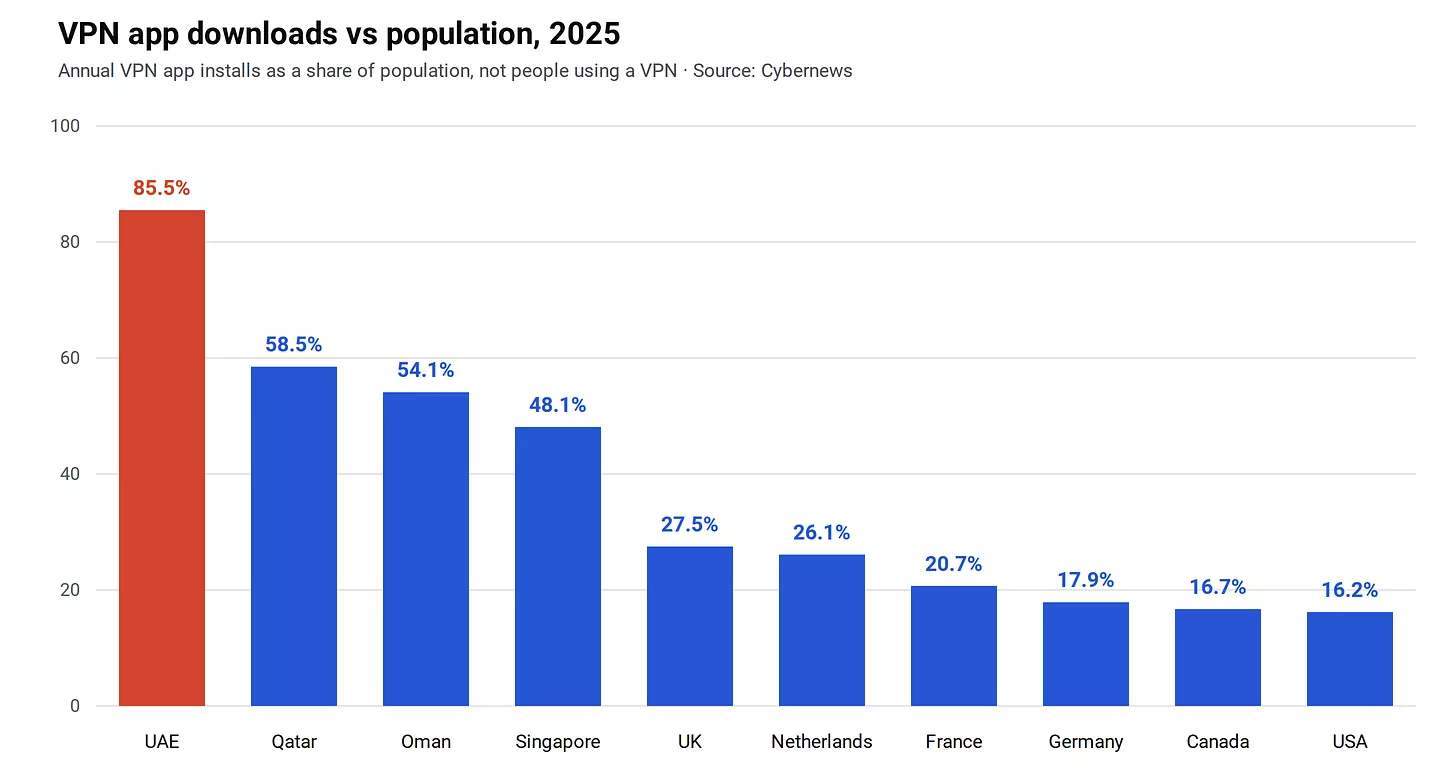
App download counts are what most country rankings run on. Cybernews built its ranking from downloads of 50 VPN apps measured against national population, which is why the UAE shows up at 85.5%. That number does not mean 85.5% of people in the UAE use a VPN. It means downloads equivalent to 85.5% of the population happened in a year, and one person cycling through four free apps looking for one that works counts four times.
Market models work backwards from revenue, and they include a lot of things that aren't a person clicking connect. Corporate remote-access licenses, network hardware and managed services all land in the same bucket as consumer subscriptions.
Now notice what none of these count properly: browser extensions. Cybernews's ranking is built from mobile apps, so an extension can't enter the count at all. Security.org's device breakdown asks about iOS, Android, Windows and macOS, which sounds comprehensive until you realize those are operating systems, and a Chrome extension on Windows may or may not get reported depending on how the respondent read the question. There is no browser extension row anywhere in the data. So if your VPN lives in Chrome or Firefox and nowhere else, which is exactly how most people who just want a video to load actually use one, you're a VPN user that most VPN usage statistics never see cleanly. We can put a size on that gap in one market at least, and we do so further down this page.
Work VPNs have the same problem in reverse: about a third of users in Security.org's data connect because their job requires it, and those people rarely downloaded anything themselves.
The practical takeaway: use survey data when you want to know how many people use VPNs, and download data when you want to know where demand is concentrated.
VPN usage by country
On download-based measures, the UAE leads the world at 85.5%, followed by Qatar and Oman. On survey-based measures, Indonesia leads. Both rankings tell you something real.
Country | Download-based adoption, 2025 |
|---|---|
United Arab Emirates | 85.50% |
Qatar | 58.47% |
Oman | 54.06% |
Singapore | 48.09% |
United Kingdom | 27.48% |
Netherlands | 26.13% |
France | 20.71% |
Germany | 17.93% |
Canada | 16.68% |
United States | 16.20% |
Source: Cybernews, downloads of 50 VPN apps measured against population.
These are selected markets rather than the global top ten: the UK ranks 7th worldwide, France 10th, Germany 15th, Canada 18th and the United States 21st.
Survey data draws a different ranking. The widely recirculated GWI country breakdown puts Indonesia at 55%, India at 43%, and the UAE, Thailand and Malaysia at 38%. Treat those exact percentages as dated, because that survey wave is several years old now, but the shape of the ranking has been remarkably durable.
What both rankings agree on is the underlying driver. The countries at the top are the countries where something popular is blocked. Gulf states have long restricted VoIP calling, so WhatsApp and FaceTime calls need a workaround. Indonesia and India have repeatedly blocked platforms outright. Western Europe sits in the teens and twenties, and Europe's numbers climbed noticeably during 2025 for reasons that have nothing to do with privacy awareness and everything to do with new laws, which we'll get to below. If you want the blocking side of this in detail, we track it in our internet censorship statistics.
The countries the data can't see
Iran is not in the Cybernews ranking at all. Not near the bottom, not with an asterisk, just absent. The App Store does not officially operate there, Google Play sits behind sanctions and blocks, and there is almost nowhere to download an app legitimately, so a count of app downloads reads close to zero. Meanwhile the research arm of Iran's own parliament reported in February 2025 that 81% of the country's internet users rely on a VPN and only 19% do not.
Russia shows the same failure in slow motion. The index has it at 4.28% in 2021, 42.20% in 2022, 23.06% in 2024 and 10.78% in 2025, a fall of 12 percentage points in a single year and one of the steepest declines anywhere in the data. Russians did not lose interest. In July 2024 Apple removed around 25 VPN services from the Russian App Store at the request of Roskomnadzor, and by September the count was close to a hundred. Protocol-level blocking, meanwhile, left many of the VPNs that could still be downloaded unable to connect. Demand moved to APK files, mirrors, self-hosted servers and configuration files passed around on Telegram, none of which produces an app store install. What the index recorded is VPNs disappearing from the shelves, not people giving them up.
We can put numbers to that, because the first blind spot lets us see into the second. Browsec is a browser extension, which is precisely the channel none of the rankings above can count.
In Russia the largest single jump in our data came in the week YouTube throttling took full effect at the start of August 2024: daily installs of our Chrome extension roughly tripled, and stayed well above their earlier level for months. Set against 2021 they run several times higher. Over the same stretch the download-based index above records Russian adoption falling from 42.20% in 2022 to 10.78% in 2025. The two measurements are not in conflict. They are counting different shelves.
Pakistan, which appears in no ranking on this page at all, shows the same shape: installs of our extension there have grown roughly sixfold since late 2021. A caveat we would rather raise than have raised for us: Browsec is one provider with its own geographic footprint, so these are movements inside our own user base and not measurements of a national market. What they can show is direction, and in both countries the direction runs opposite to what the download rankings report.
That is the second blind spot in this data, and it runs the opposite way to the first. The browser extension gap is roughly the same size everywhere. This one scales with censorship: the harder a country blocks, the lower it ranks on downloads, because its users move to distribution channels nobody counts. Worth holding onto when you reach the demand spikes further down this page, where Iran and Russia post some of the largest jumps on record, in a table built from search behavior rather than installs.
VPN usage in the United States
Depending on which survey you pick, either 16%, 46% or 60% of Americans use a VPN. This is the clearest example of the measurement problem anywhere in the data.
Figure | Question asked | Source |
|---|---|---|
60% | Used a VPN at any point in the past year | AllAboutCookies, April 2026 |
46% | Currently uses a VPN, personal or work | Security.org, 2026 update |
39% | Currently uses a VPN, personal or work | Security.org, previous wave |
16.2% | Download volume measured against population | Cybernews, 2025 |
The move from 39% to 46% inside Security.org's own tracking is the most useful figure in that table, because the methodology stayed the same between the two waves. Their breakdown puts about half of VPN users on personal use only, 28% on work use only and 22% on both. Treat that first number carefully in the wild: Security.org also states it as 23% of all respondents, and the two framings are easy to mix up. Among personal users, men outnumber women 57% to 43%, and the heaviest usage sits with adults under 30.
What people actually use VPNs for
Security is the most cited reason, and public Wi-Fi is the most common specific situation.
When Security.org asked American VPN users why they connect, close to half said general security, meaning things like avoiding identity theft. Another 40% said general privacy. About a third connect on public Wi-Fi, about a third are required to by an employer, and 9% each cited getting around restrictions at school, at the office, or imposed by a government.
Notice the shape of those answers. The two biggest categories are broad and abstract, the kind of thing you say when someone asks you to justify a choice you made for several overlapping reasons. The specific, checkable triggers sit lower: a coffee shop network, an employer's policy, a blocked site.
That last category, the 9% getting around a government restriction, is the one worth treating with suspicion. It's a self-reported figure, collected from a US sample, about an activity people in more restrictive countries have obvious reasons not to discuss with a stranger running a survey. Set it next to the demand data further down this page, where every single major spike on record was triggered by something being blocked, and 9% starts to look like a floor rather than a measurement. Public Wi-Fi is the friendlier end of the same instinct, and we went through what that protection is really worth in whether public Wi-Fi is safe to use. The wider case sits in the reasons people use a VPN.
Free vs paid VPN users
Around two thirds of VPN users pay for one, and roughly a third use something free.
Security.org's data has 64% of American users on a paid subscription (26% paying personally, 25% covered by an employer, 13% some combination of the two) and 30% on a free service. Worth noticing inside that 64%: a large chunk isn't a consumer decision at all. A quarter of all users have a VPN because an employer bought it, which is a reminder that "paid user" and "customer" aren't the same population.
Price shapes the rest. Security.org priced 30 major providers in April 2026, and the pattern is less about which VPN you pick than about how long you commit.
Plan length | Average cost per month |
|---|---|
Month to month | $11.79 |
6 months | $6.99 |
12 months | $4.82 |
24 months | $3.81 |
36 months | $3.32 |
Source: Security.org, average across 30 VPN providers, April 2026.
A three-year plan costs about 28% of the month-to-month rate. That gap is the entire commercial model of the paid VPN industry, and it's also why the honest comparison for most people isn't free versus $11.79. It's free versus roughly $4 a month, paid a year at a time.
Free tiers vary enormously in what they are. Some are a limited slice of a paid product, funded by the people who upgrade. Some are funded by selling something, and if it isn't a subscription, it's usually data. So the useful question isn't free versus paid, it's whether the provider will tell you plainly how it makes money and what it logs. That answer should fit in one short paragraph on a privacy policy page. If it takes six, that's the finding.
Browsec Ücretsiz ve Premium
Premium'a geçtiğinizde neler kazanırsınız: daha yüksek hız, daha fazla konum ve tüm cihazlarınızda tam koruma.
Ücretsiz
$0.00 aylık
- Askeri düzeyde şifreleme
- Reklamsız
- 1000 Mbit/s
- 46+ ülkede 1.000+ sunucu
- Tam bilgisayar koruması için masaüstü uygulaması
Works in Chrome, Firefox,
iOS and Android
iOS and Android
Premium
Sadece $2.99 aylık
- Askeri düzeyde şifreleme
- Reklamsız
- 1000 Mbit/s
- 46+ ülkede 1.000+ sunucu
- Tam bilgisayar koruması için masaüstü uygulaması
Risk İçermeyen 7 Günlük Para İade Garantisi
When VPN demand spikes
Within hours. Top10VPN tracks daily VPN search volume by country against the previous 30-day average, and the pattern is consistent enough to set your watch by. A platform gets blocked, and demand climbs by a factor of ten to a factor of several hundred before the day is out.
One caveat on reading these numbers: this is demand, not usage. It measures people looking for a VPN, not people who successfully installed one.
Country | Date | Demand vs prior 30-day average | Trigger |
|---|---|---|---|
Iran | 26 May 2026 | +934% | Internet restored after an 88-day blackout, filtering still in place |
Uganda | 18-27 Jan 2026 | +2,557% | Election-period shutdown and social media blocks |
Australia | 6-9 Mar 2026 | +330% | Age verification rules for adult sites |
Nepal | 4-7 Sep 2025 | +2,892% | Ban on Facebook, WhatsApp, X and Instagram |
Afghanistan | 8-14 Oct 2025 | +574% | Taliban blocks on Facebook, Instagram and Snapchat |
United Kingdom | 25-27 Jul 2025 | +1,987% | Online Safety Act age checks |
France | 4-6 Jun 2025 | +570% | Age verification rules for adult sites |
United States | 19 Jan 2025 | +827% | TikTok going dark |
Mauritius | 1 Nov 2024 | +24,001% | Pre-election social media blackout |
Source: Top10VPN VPN Demand Statistics.
We can test that caveat, because several of the events above are ones we can measure directly. Search demand and installs turn out to agree closely on censorship events.
Event | Search demand (Top10VPN) | Browsec installs |
|---|---|---|
Nepal, 26 platforms blocked, 4 Sep 2025 | +2,892% | +3,040% |
Türkiye, social media throttled, 19 Mar 2025 | +188% | +306% |
United Kingdom, Online Safety Act, 25 Jul 2025 | +1,987% | +94% |
Browsec Chrome extension installs, peak day against the mean of the previous 30 days.
Mauritius holds the record. A 24,001% single-day jump, the largest Top10VPN has ever measured, after the government blacked out social media ahead of a general election.
The UK case is the one worth studying, because it's the best documented. When the Online Safety Act's age checks took effect on 25 July 2025, Proton VPN reported UK sign-ups up around 1,400% within minutes, NordVPN reported roughly 1,000%, and Top10VPN's demand reading climbed across three consecutive days instead of spiking once and collapsing.
That points at two different patterns hiding inside the same table. Censorship spikes are enormous and short: the block lands, demand explodes, and it decays once people either get connected or give up. Regulation spikes are smaller and stickier, because the rule isn't going away next week. France, the UK and Australia all show the second shape, and all three are wealthy countries where VPN adoption had been flat for years. That's the single clearest driver behind European growth in this data. For the shutdown side of the picture, we keep a running count in our statistics on internet shutdowns.
The VPN market in numbers
The global VPN market was worth somewhere between $54 billion and $89 billion in 2025, depending on what you count as a VPN.
Firm | 2025 market size | CAGR | Forecast |
|---|---|---|---|
Fortune Business Insights | $69.82bn | 19.10% | $336.67bn by 2034 |
Precedence Research | $88.96bn | 22.04% | $534.22bn by 2034 |
IMARC Group | $54.10bn | 12.11% | $155.90bn by 2034 |
A $35 billion gap between research firms sounds like someone made a serious mistake, but it's mostly definitional. The wider estimates fold in enterprise remote-access infrastructure, network hardware and managed services. The narrower ones stay closer to software licenses. Consumer subscriptions, the kind you would personally buy, are a minority share of every one of these figures.
Growth forecasts in the 12% to 22% range deserve a raised eyebrow too, given that the share of internet users reporting VPN use hasn't moved in three years. Revenue can grow while the user base sits flat, through price increases, bundling and enterprise expansion. It just isn't the same thing as adoption.
What these numbers tell you
Global VPN adoption is stable, not exploding. Roughly a quarter of internet users, holding steady for three years running.
National adoption is anything but stable. It's driven by what's blocked where, and it can move by thousands of percent in a single day.
Every headline percentage is downstream of a methodology choice. Ask what question the survey asked, or what the download count counted, before repeating the number anywhere it matters.
Download-based rankings are least reliable exactly where VPNs matter most. A country that blocks hard pushes its users onto sideloading and self-hosting, and its download figure falls while real usage climbs. For Iran, Russia or China, treat those rankings as a measure of app store access rather than of adoption.
And most of these datasets have a blind spot shaped exactly like a browser extension. The real number of people routing some of their traffic through a VPN is almost certainly higher than any of them report.
Browsec şu platformlarla uyumludur:
Frequently asked questions
How many people use a VPN?
About 23% of internet users aged 16 and over, per GWI data published in the Digital 2026 Global Overview Report, which works out to roughly 1.4 billion people. Download-based counting puts it at 12%. Higher figures circulate widely but have no published methodology behind them.
Which country uses VPNs the most?
By download volume measured against population, the UAE at 85.5%, followed by Qatar (58.5%) and Oman (54.1%). By survey, Indonesia has consistently ranked first, at 55% in the most widely cited GWI breakdown.
Why isn't Iran in the VPN usage rankings?
Because those rankings count app store downloads, and Iran barely has an app store. The App Store does not officially operate there and Google Play is restricted, so downloads read close to zero. Survey evidence points the other way entirely: Iran's own parliamentary research centre put VPN use at 81% of internet users in February 2025.
Is VPN use growing or shrinking?
Globally it's pretty much flat. The GWI measure has stayed between 22.7% and 24.7% since 2023. Individual countries are a different matter, with the UK, France and Australia all recording sharp increases after new age-verification laws took effect.
What percentage of Americans use a VPN?
Around 46% currently use one for personal or work reasons, up from 39% a year earlier in the same survey. About 60% say they've used one at some point in the past year.
Are VPNs legal?
In most countries, yes. A small group of countries restricts or bans them, including China, Russia, Iran, North Korea, Turkmenistan and Belarus, and enforcement ranges from nominal to serious depending on where you are.
Sources
Browsec, Chrome Web Store install data for the Browsec extension, daily by country (original analysis)
DataReportal / We Are Social, Digital 2026 Global Overview Report (GWI data)
Privacy Terms, AllAboutCookies US survey (April 2026)
TechCrunch, Apple removes VPN apps at request of Russian authorities, say app makers
Iran International, 81% of Iranian internet users bypass censorship with VPNs (published 24 Feb 2025)
Bu makaleye atıf yapın
Browsec. "How Many People Actually Use a VPN in 2026." Browsec Blog, 25 Ağustos 2026 Salı, https://browsec.com/tr/blog/vpn-usage-statistics.